 Note Names
Trombone slide positions chart
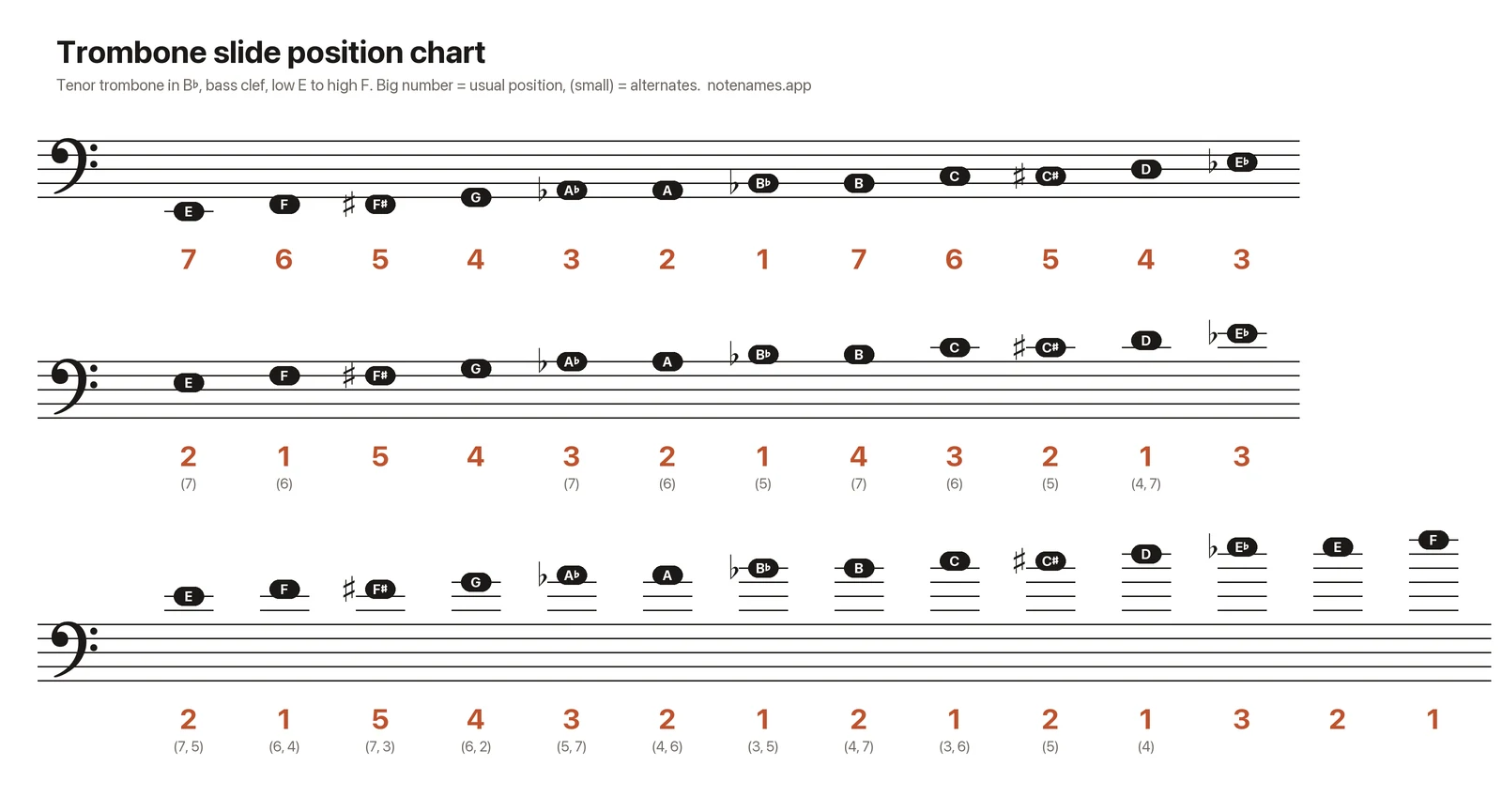
A tenor trombone has seven slide positions. 1st position (slide all the way in) plays B♭, F, B♭, D and F; each position further out is a half step lower, down to 7th position: E, B, E, G♯ and B. Here is the chart, as notes on the bass clef and as a table.
Slide position chart: the notes in each position
Each column is one position, lowest note at the bottom. You move between the notes in a column with your lips (the partials, or harmonics); you move between columns with the slide. Middle C is C4.
| Position | 1 | 2 | 3 | 4 | 5 | 6 | 7 |
|---|---|---|---|---|---|---|---|
| Partial 6 | F F4 | E E4 | E♭ E♭4 | D D4 | D♭ / C♯ D♭4 | C C4 | B B3 |
| Partial 5 | D D4 | C♯ / D♭ C♯4 | C C4 | B B3 | B♭ B♭3 | A A3 | G♯ / A♭ G♯3 |
| Partial 4 | B♭ B♭3 | A A3 | A♭ A♭3 | G G3 | G♭ / F♯ G♭3 | F F3 | E E3 |
| Partial 3 | F F3 | E E3 | E♭ E♭3 | D D3 | D♭ / C♯ D♭3 | C C3 | B B2 |
| Partial 2 | B♭ B♭2 | A A2 | A♭ A♭2 | G G2 | G♭ / F♯ G♭2 | F F2 | E E2 |
Tenor trombone in B♭, no F attachment. Partial 1, the pedal tone, is an octave below partial 2 in each position (pedal B♭ in 1st). Partial 5 (the D, C♯, C … row) sits a little flat, so players pull those notes up a touch, or bring the slide in slightly.
Every note from low E to high F (printable chart)
How the positions work
1st position is the slide all the way in; 7th is fully out. Each position is a half step lower than the one before. In 1st position you can play B♭, F, B♭, D and F going up; in 2nd position the same pattern a half step lower (A, E, A, C♯, E), and so on. That is why many notes have two positions: the higher you play, the more choices you get.
Note by note, with alternate positions
Tenor trombone in B♭, without an F attachment. The first number is the usual position; the alternates follow in brackets.
| Note | Position | Note | Position |
|---|---|---|---|
| E (low, below the bass staff) | 7 | E (just above middle C) | 2 (7, 5) |
| F | 6 | F | 1 (6, 4) |
| F♯ / G♭ | 5 | F♯ / G♭ | 5 (7, 3) |
| G (bottom line of the bass staff) | 4 | G | 4 (6, 2) |
| A♭ | 3 | A♭ | 3 (5, 7) |
| A | 2 | A | 2 (4, 6) |
| B♭ | 1 | B♭ | 1 (3, 5) |
| B | 7 | B | 2 (4, 7) |
| C | 6 | C | 1 (3, 6) |
| C♯ / D♭ | 5 | C♯ / D♭ | 2 (5) |
| D (middle line) | 4 | D | 1 (4) |
| E♭ | 3 | E♭ | 3 |
| E | 2 (7) | E | 2 |
| F (4th line) | 1 (6) | F (high) | 1 |
| F♯ / G♭ | 5 | ||
| G (top space) | 4 | ||
| A♭ | 3 (7) | ||
| A (top line) | 2 (6) | ||
| B♭ | 1 (5) | ||
| B | 4 (7) | ||
| Middle C | 3 (6) | ||
| C♯ / D♭ | 2 (5) | ||
| D | 1 (4, 7) |
The left column runs from low E up to the D above middle C; the right column continues from that E to high F. Middle C is in 3rd position, the D above it in 1st or 4th.
F attachment and bass trombone
A tenor trombone with an F attachment, and every bass trombone, has a trigger that lowers the instrument from B♭ to F. Without the trigger the positions are exactly the ones in the chart. With it, notes that would need the far 6th and 7th positions can be played with the slide much closer in: low C is about 1st position with the trigger, and the B below it about 2nd. With the trigger down the positions also sit a little further out than usual, so check those notes by ear.
Tips
- Learn 1st, 3rd and 4th first: B♭, F, D (1st), C and E♭ (3rd), G and D (4th) cover most beginner tunes.
- Use an alternate position to avoid a long slide between two fast notes, e.g. F in 6th next to C in 6th.
- Higher parts often switch to tenor clef; the positions stay the same, only the clef changes.
Slide positions on your own part
Note Names reads a trombone part from a PDF or a photo of the page and writes the slide position on every note (1 to 7, from the chart above), in bass or tenor clef. When a page looks like a trombone part, the app offers "Trombone part? Show slide positions". Notes outside the chart keep their letter name. Slide positions come with the one-time unlock (US$9.99, no subscription), along with unlimited imports; letter names are free to try.
Questions
What are the 7 positions on a trombone?
Seven slide positions, 1st with the slide all the way in to 7th fully out, each a half step lower. 1st position plays B♭, F, B♭, D and F; 7th plays low E and B.
Is there a printable trombone slide chart?
Yes: the chart image on this page covers every note from low E to high F, with the usual position and the alternates. Open it full size to save or print it.
What does the F attachment change on a trombone?
The trigger lowers the instrument from B♭ to F, so low notes that normally need 6th or 7th position can be played with the slide further in: low C near 1st position, and the B below it near 2nd.
What position is middle C on trombone?
3rd position (6th as an alternate). The B♭ below it is 1st and the D above it is 1st or 4th.
Is there an app that shows trombone slide positions on sheet music?
Yes. Note Names reads a trombone part from a PDF or photo and writes the slide position on every note, in bass or tenor clef. Slide positions come with its one-time US$9.99 unlock.