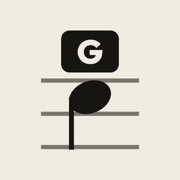
 Note Names
How to read sheet music
Sheet music answers two questions for every note: which note, and for how long. Learn those two and the rest is detail. Here is the order that works for most beginners.
1. The staff
Music is written on a staff of five lines and four spaces. A note's height on the staff tells you its pitch: higher on the page means higher in sound. Each step from a line to the next space (or space to line) is the next letter of the musical alphabet, which only uses seven letters: A B C D E F G, then it starts again at A.
2. The clef
The symbol at the start of each staff tells you which letter belongs to which line. Piano music uses two staves joined together: the treble clef on top (usually the right hand) and the bass clef below (usually the left hand).
3. Note names
Learn the lines and spaces of one clef first. Rhymes help (Every Good Boy Does Fine for the treble lines, FACE for the spaces), but the faster habit is to learn a few landmark notes and read everything else as a step or skip away from them. Notes above or below the staff sit on ledger lines.
4. Rhythm: how long each note lasts
The shape of a note tells you its length, counted in beats:
- Whole note (open, no stem): 4 beats in 4/4 time.
- Half note (open, with a stem): 2 beats.
- Quarter note (filled, with a stem): 1 beat.
- Eighth note (filled, with a flag or beam): half a beat. Two eighths fill one beat.
A dot after a note adds half its length again, so a dotted half note lasts 3 beats. Rests are silences with the same lengths.
5. Time signature and bars
The two numbers after the clef are the time signature. The top number is how many beats are in each bar; the bottom number says which note gets one beat (4 means a quarter note). In 3/4, the time of most minuets and waltzes, you count 1 2 3, 1 2 3. Vertical bar lines divide the music into those bars.
6. Key signature
Sharps or flats right after the clef are the key signature. They change those notes everywhere in the piece: with one sharp on the F line, every F is played as F♯. This is the detail beginners miss most often.
A practice plan that works
- Little and often. Ten minutes a day beats an hour on Sunday.
- Read real music early. Simple pieces you want to play keep you going longer than drills.
- Say the names out loud as you play, then try a line without saying them.
- Use letters as a bridge, not a crutch. Label the notes to get a piece going, then remove the labels as it becomes familiar.
Questions
What is the fastest way to learn to read sheet music?
Learn one clef at a time, memorise a few landmark notes, and read a little real music every day, saying the note names as you play.
What are the seven note names?
A, B, C, D, E, F and G. After G the alphabet starts again at A, one octave higher.
Do I need to read music to play piano?
No, many people play by ear or from chord charts. Reading opens up the written repertoire and makes learning new pieces much faster.